
Criminal Court Records in Kay County
A criminal court record is the official case file the Kay County Court Clerk opens the moment a prosecutor files a charge. The Court Clerk, Marilee Thornton, is the custodian of District Court case files, which include every felony and misdemeanor matter brought in the county. The file grows as the case moves. It holds the charging document, bond papers, docket entries, the plea, hearing notes, and the judge's final orders. This is a court record, not a jail blotter. The booking side of an arrest is tracked separately, and the formal charge itself is detailed in the county arrest and court charge records.
Kay County sits in Judicial District 8 and shares that district with Noble County. The District Court in Newkirk is the trial court of general jurisdiction, so it handles serious crimes and lesser offenses alike. Felony cases carry a CF case prefix, and misdemeanors carry a CM prefix. Municipal courts in Ponca City, Blackwell, and Tonkawa handle city ordinance and municipal traffic offenses on their own dockets. Those city cases usually do not appear in the District Court case search, so a complete picture sometimes means checking both the county and the city court.
How to Search Kay County Criminal Court Records
The main online path is On Demand Court Records, the system the Court Clerk links for tracking criminal case progress. ODCR covers Kay County District Court and lets a user search felony proceedings, misdemeanor proceedings, criminal probable cause, drug court, and youthful offender case types. Searches by name or case number are free to run, though some document images may need an account or payment.
- Open ODCR at odcr.com, choose Oklahoma District Courts, then select Kay as the court.
- Enter the defendant name in Last, First order, or type the full case number if you already have it.
- Narrow the results by case type, such as Criminal Felony Proceedings, and by a filed date range.
- Open a matching case to read the docket entries, charges, plea, and disposition.
- Request a certified copy from the Court Clerk in Newkirk when a stamped, official record is needed.
The Oklahoma State Courts Network is the judiciary's own docket system, and Kay County District Court appears in its county list. Run a statewide criminal case search through OSCN dockets when a case may sit in another county. For files that never moved online, older paper cases, or sealed-record questions, the Court Clerk counter remains the reliable fallback. A broader walk through every record type the county keeps lives in the general Kay County court records overview.
Stages of a Kay County Criminal Case
A criminal case moves through a set sequence, and each step leaves its own mark in the record. Reading the docket in order shows where a case stands, whether it is still pending, and how it ended. The flow below is the path most felony and misdemeanor matters follow in the District Court.
Case flow: Charges Filed › Arraignment › Pretrial / Motions › Plea or Trial › Disposition › Sentencing
| Stage | What Happens |
|---|---|
| Arraignment | The defendant first appears, hears the charges read, and enters a plea of guilty, not guilty, or no contest. Bond and conditions of release are set or reviewed. |
| Pretrial / Motions | Both sides exchange evidence and file written motions. The judge rules on requests to suppress evidence, change bond, or continue the case. |
| Plea or Trial | Many cases close with a negotiated plea. Others go to a jury or judge, where guilt must be proven beyond a reasonable doubt. |
| Sentencing | After a plea or guilty verdict, the court imposes a sentence that may combine prison or jail, probation, fines, court costs, and restitution. |
Not every case reaches every stage. Charges can be dismissed at arraignment, dropped during pretrial, or resolved through a deferred judgment that delays a finding of guilt while the defendant meets court conditions. The docket records each of those turns with a dated entry.
Note: A case can stay open for months between settings, so a record showing no disposition often means the matter is still pending rather than closed.
What a Kay County Criminal Court Record Shows
The District Court case file is organized around a handful of core fields, and the same fields appear in the online docket view. Together they identify the parties, name the offense, and report the outcome. The table walks through the entries a reader sees most often when opening a criminal case.
| Field | What It Shows |
|---|---|
| Case Number | The unique number with a prefix, such as CF for felony or CM for misdemeanor, plus the filing year. |
| Defendant | The person charged. The State of Oklahoma appears as the prosecuting party on the other side. |
| Charges | Each count, its statute, the offense date, and the severity level filed by the prosecutor. |
| Bond | The amount and type of bond set, such as cash or surety, and any release conditions. |
| Plea | The defendant's answer to the charge, entered as guilty, not guilty, or no contest. |
| Disposition | The result for each count, such as dismissed, convicted, deferred, or acquitted. |
| Sentence | The punishment ordered, including any jail or prison term, probation, fines, costs, and restitution. |
Alongside these fields, the docket lists every filing in date order: motions, orders, minute entries, hearing settings, continuances, warrants, and cost assessments. Financial lines track fines, fees, restitution, and any payment plan. Some entries are redacted, because personal identifiers like Social Security and account numbers are protected under court rules.
Reading Kay County Criminal Dispositions
The disposition is the line that tells a reader how a count ended, and it carries more weight than any other entry. A single case can hold different dispositions for different counts, so each one should be read on its own. The sentence then sets out what the court ordered, and it often blends several penalties at once rather than a single term.
- Guilty: the defendant admitted the offense or was found guilty at trial.
- Not guilty or acquitted: the court did not find guilt, and no conviction is entered.
- Dismissed: the count was ended, with or without prejudice, depending on whether it can be refiled.
- Deferred judgment: a finding of guilt is delayed while the defendant meets set conditions.
- Nolo contendere: a no-contest plea, which the court treats like a guilty plea for sentencing.
A sentence that reads as a suspended term means the time is not served unless the defendant violates probation. Costs and restitution stay due regardless of how custody is handled, and a later revocation entry shows when probation was pulled back. Reading these lines together gives the true outcome of a case.
Charges Versus Convictions
Being charged is not the same as being convicted, and a criminal court record makes that gap visible. The same file can show counts that were dropped, dismissed, reduced, or that ended in an acquittal at trial. Treating a filed charge as a final result is the most common mistake a reader can make. The comparison below separates the two stages.
| Charge | Conviction | |
|---|---|---|
| Stage | Accusation by the prosecutor | Verdict or accepted plea |
| Burden of Proof | Probable cause | Beyond a reasonable doubt |
| Can It Change | Yes, amended, reduced, or dropped | Stands unless appealed or vacated |
| Public Record | Yes | Yes |
A clean read of the disposition column settles the question. If the count shows a conviction, the charge was proven or admitted. If it shows a dismissal or acquittal, the accusation did not hold, even though the original charge still sits in the file.
The Kay County District Attorney's Role
State criminal charges in Kay County come from the District Attorney for District 8, Brian Hermanson. The District Attorney decides what to file, what to amend, and what to dismiss, and that office drives the charging entries in every felony and misdemeanor case file. The Kay County office sits inside the courthouse at 201 S. Main in Newkirk, with a phone line at 580-362-2571.
The office also handles certain post-judgment payments tied to criminal cases. The District Attorney District 8 page lists Kay County payment categories that include the 991 cost payment, victim restitution, bogus check payment, and district attorney supervision. Those payments often show up as financial entries in a case docket, which is why the prosecutor's role reaches well past the first filing.
Note: The District Attorney prosecutes state charges filed in District Court, while city prosecutors handle municipal cases in Ponca City, Blackwell, and other local courts.
Appointed Counsel in Kay County Criminal Cases
Defendants who cannot afford a lawyer may qualify for appointed counsel, and the record shows when the court makes that appointment. In Oklahoma, indigent defense outside the largest metro counties runs through the Oklahoma Indigent Defense System. Its stated mission is to give indigent people legal representation comparable to what those who can pay would receive, handled in a cost-effective way.
The Oklahoma Indigent Defense System publishes its statewide mission and resources online for defendants and families.
The state agency overview comes straight from the Oklahoma Indigent Defense System portal.

To start the process in Kay County, a defendant fills out the Court Appointed Counsel Application listed under the criminal forms on the Court Clerk's forms page. The judge reviews eligibility and enters an appointment order when it is granted. That order, and the name of appointed or retained counsel, appears in the case docket alongside the other filings.
Drug Court and Specialty Programs in Kay County
Some criminal cases route into a specialty docket rather than a standard sentence, and those entries appear in the record too. Oklahoma's adult drug courts give eligible nonviolent felony defendants a structured, court-supervised treatment program in place of incarceration. The statewide program began in 1995 and has expanded to most of the state's counties.
The state's drug court overview, published by the Oklahoma Department of Mental Health and Substance Abuse Services, explains who qualifies and how the supervised model works.
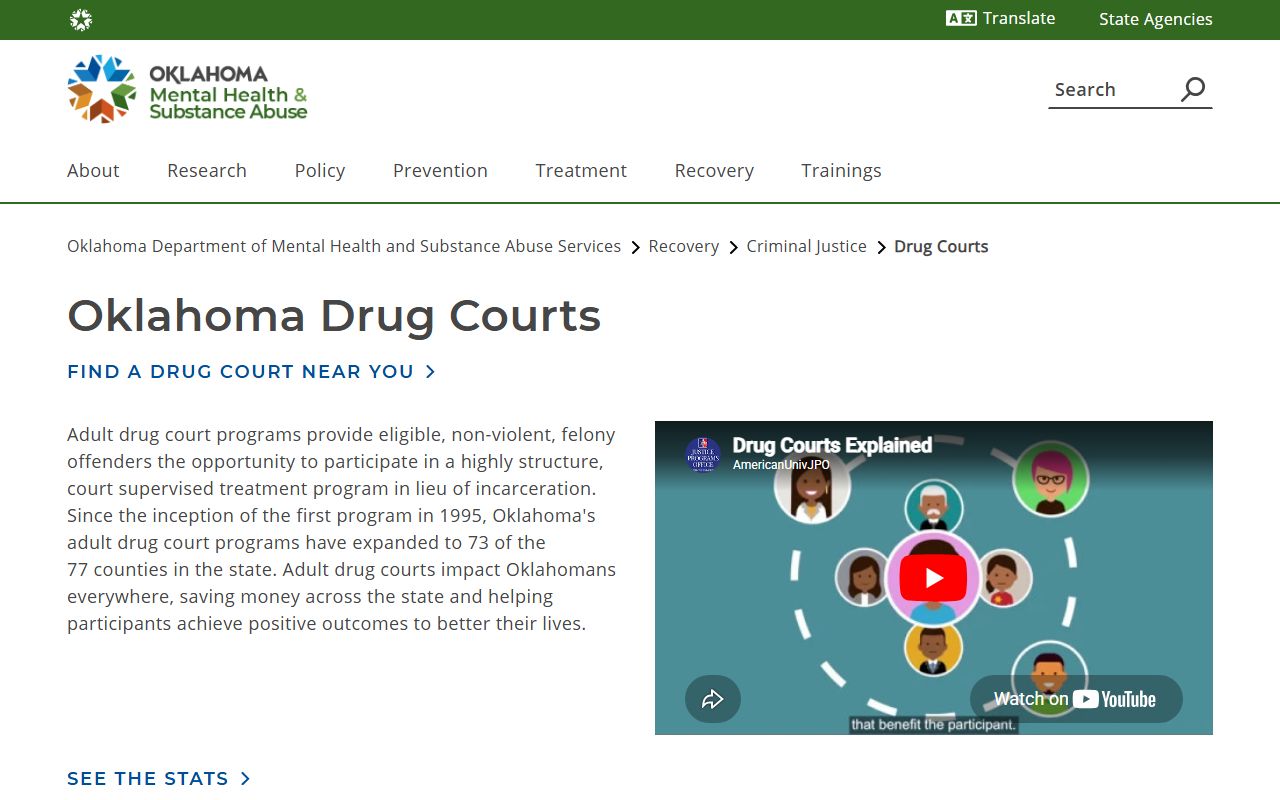
ODCR lists Drug Court as one of its searchable case types, so a Kay County reader may see drug-court settings inside the District Court docket. The system also lists a mental health court category tied to the Anna McBride Act. Because program availability changes, the safest step is to confirm current District 8 specialty options with the Court Clerk, the District Attorney, defense counsel, or the sentencing judge before relying on any single docket entry.
Sealed Versus Expunged Records
Oklahoma law lets eligible people limit public access to qualifying criminal records, and the terms sealed and expunged are not interchangeable. Both flow from a petition filed in District Court under Title 22 of the Oklahoma Statutes, sections 18 and 19. The court weighs eligibility and the statutory standard, and if it grants the order, that order controls which agencies must hide or remove the record.
| Sealed | Expunged | |
|---|---|---|
| Visibility | Hidden from public view | Removed and treated as if it never existed |
| Law Enforcement | Limited access remains | Very limited access |
| How It Starts | Petition under 22 O.S. 18 and 19 | Petition under 22 O.S. 18 and 19 |
| Eligibility | Set by statutory category and court review | Set by statutory category and court review |
Online dockets do not always vanish the instant an order is signed, because agencies need time to process the sealing. If the underlying case came from a municipal court, the requester may also have to coordinate with that city court. The Court Clerk handles filing logistics, while questions about eligibility are best taken to a lawyer.
Public Access to Kay County Criminal Court Records
Criminal case files in the District Court are public records under Oklahoma law, and a requester usually starts with the office that holds the record. For these files that office is the Kay County Court Clerk. The Oklahoma Open Records Act supports inspection and copying of public records during business hours, except where a specific law makes a record confidential.
Key Statutes:
Oklahoma Statutes Title 51 § 24A.5 - public records are open during regular business hours unless a law specifically makes them confidential.
Oklahoma Statutes Title 51 § 24A.8 - law enforcement agencies must release basic arrest and incident information, while investigatory details can be limited.
The plain-English version is simple. District Court case files, criminal matters, and certified copies route to the Court Clerk, while the Open Records Act framework is set out in the state's Open Records Act listing. Confidential juvenile, sealed, expunged, and mental-health records should never be assumed open.
Sentenced Inmates and Statewide Lookups
A criminal court record ends with the sentence, but it does not follow a defendant into prison. Once a person is sentenced to state custody, the Oklahoma Department of Corrections takes over the offender record. The statewide OK Offender Lookup reports current custody status, location, and a summary of the offense and term.
The Department of Corrections cautions that its data is abbreviated and may not be an exact account of the offense, sentence, or time to be served, so the court file remains the authoritative source for the details of a case. For local custody before sentencing, the Kay County Detention Facility in Newkirk handles booking and jail questions. Reading the District Court record and the corrections lookup together shows both how a case was decided and where the person is now.
Background Check Considerations
A name search in ODCR or OSCN is a casual lookup, not a regulated background check. Employers, landlords, and lenders that make decisions about a person must use a screening process that follows the federal Fair Credit Reporting Act. Court dockets can also contain name matches between different people, so a hit alone never confirms identity without the case detail.
Important: This site is not a consumer reporting agency under the Fair Credit Reporting Act, and its records cannot be used for employment, credit, housing, or tenant screening decisions.
Restricted Kay County Criminal Court Records
Not every criminal matter is open to the public, and the District Court withholds several categories by law. Juvenile court records and related agency, prosecutor, and law enforcement records are generally confidential under Title 10A of the Oklahoma Statutes, with access limited to the parties and people the statute names. The juvenile confidentiality provisions are set out in Oklahoma Statutes Title 10A.
Sealed and expunged cases drop out of the public docket once an order is processed. Mental-health proceedings can be protected, and adoption files are highly restricted even though they share a courthouse with ordinary case types. Personal identifiers are redacted across the board. When a record does not appear in an online search, that absence may reflect a restriction rather than a gap, and the Court Clerk can confirm whether a file exists but is sealed.