
Where Kay County Probate Records Are Filed
Probate in Oklahoma is not handled by a stand-alone probate court. The work is done inside the District Court, the state's trial court of general jurisdiction. Kay County belongs to Judicial District 8, which it shares with Noble County. When someone dies and an estate must be settled, the case is opened as a probate proceeding in that District Court. The Kay County Court Clerk is the office that accepts the filing, assigns the case number, and keeps the file.
This matters for anyone searching. There is no separate "Kay County Probate Court" address, phone line, or website to look up. The destination is the Court Clerk at the Kay County Courthouse in Newkirk. The same office that handles civil, criminal, and family cases also handles wills, estates, and guardianships. A judge of the District Court signs the orders, but the public-facing custodian of the record is the clerk.
Because probate rides inside the District Court system, the same online tools used for other case types also reach probate files. That keeps the search path simple once the structure is clear.
Note: Oklahoma has no separate probate court, so every Kay County probate matter is filed and stored as a District Court proceeding through the Court Clerk.
What Probate Covers in Kay County
Probate is the court process for settling what a person leaves behind and for protecting people who cannot manage their own affairs. In Kay County the District Court probate docket holds several related matters. The most common is the estate of someone who has died, whether or not they left a will. Alongside estates, the court hears guardianship cases for minors and incapacitated adults, conservatorship requests, and certain trust proceedings.
An estate case decides who inherits, who pays the debts, and who carries out the plan. If the person left a valid will, the court confirms it and follows its terms. If there was no will, Oklahoma's intestate succession rules decide who receives the property. Either way, the court appoints a personal representative to gather assets, notify creditors, and distribute what remains.
Guardianship and conservatorship cases protect a different group: children without a capable parent, and adults who can no longer handle money or personal decisions. These files often contain sensitive medical or financial material, so parts of them may be limited even though the case itself is in the public docket.
Probate Terms Defined
Probate paperwork is full of legal words that rarely come up in daily life. A short glossary helps when reading a Kay County estate or guardianship file.
- Testator
- The person who made the will. The will speaks for the testator after death and names who should inherit and who should manage the estate.
- Executor
- The person named in the will to carry out its terms. In Oklahoma this role is often called the personal representative once the court grants authority.
- Intestate
- Dying without a valid will. When this happens, state law decides who inherits and the court appoints an administrator instead of an executor.
- Guardianship
- A court arrangement giving one person legal authority over the personal care of a minor or an incapacitated adult who cannot care for themselves.
- Conservatorship
- A court arrangement focused on managing the money and property of someone who is unable to handle their own financial affairs.
How to Search Kay County Probate Records
Most people begin a Kay County probate records search online. Two free state systems carry District Court dockets. The first is On Demand Court Records (ODCR), which the Court Clerk links directly and which lists Kay as a selectable court. The second is the Oklahoma State Courts Network (OSCN) docket search, where Kay County District Court appears in the county menu. Probate cases carry the case-number prefix PB, so a known case number speeds things up.
On ODCR, choose Kay as the court, then set the case type to Probate Proceedings. You can search by a decedent's name, by party, or by full case number. OSCN works in a similar way and is the state judiciary's own path. Online dockets show the filings and entries, though document images sometimes require an account or a fee. When a file is old, sealed in part, or not yet digitized, the counter in Newkirk is the fallback.
- Open ODCR and select Kay as the court, or open OSCN and select Kay County District Court.
- Set the case type to Probate Proceedings, or enter a PB case number if you already have one.
- Search by the decedent's name, then open the matching case to read the docket entries.
- If nothing appears online, call or visit the Court Clerk at 580-362-3350 to check the paper file.
Note: Probate cases use the PB prefix in Kay County, so searching by that case number is the fastest way to land on the right estate file.
Filing a Kay County Probate Case
New probate cases are filed in person or by mail with the Court Clerk. The office sits inside the Kay County Courthouse in Newkirk and also keeps a post office box for mailed filings. Staff can answer questions about case status, copies, and counter procedure, but they cannot give legal advice or tell a filer how to draft a petition. The contact details below are the single point of entry for opening or reviewing a probate matter in the county.
Kay County Court Clerk
201 S. Main St.
Newkirk, OK 74647
Mailing: P.O. Box 428, Newkirk, OK 74647
580-362-3350
Mon-Fri 8:00 a.m.-12:00 p.m. and 12:45 p.m.-4:30 p.m.
Land records are a separate matter handled by a different office. If a probate estate includes real property, deeds and mortgages are recorded at the Kay County County Clerk, not the Court Clerk. That office is a short walk away and keeps its own files.
Kay County County Clerk (Land Records)
219 S. Main St.
Newkirk, OK 74647
Mailing: P.O. Box 450, Newkirk, OK 74647
580-362-2537
Mon-Fri 8:00 a.m.-4:30 p.m.
Kay County Probate Filing Fees
The Court Clerk publishes a single fee schedule covering every District Court case type, including probate and guardianship. A standard probate filing carries one fee, while a motion to sell estate property under Title 58 of the Oklahoma Statutes carries its own. Guardianship fees vary by who files and whether an attorney is involved, with reduced amounts for a relative acting on a family member's behalf. The figures below come from the published Kay County fee schedule.
| Item | Amount |
|---|---|
| Probate filing | $220.39 |
| Motion for sale under 58 O.S. 239 | $92.89 |
| Guardianship, relative with attorney | $67.00 |
| Guardianship, relative pro se | $57.00 |
| Guardianship with attorney | $220.39 |
| Guardianship pro se | $210.39 |
| Guardianship annual report | $82.89 |
| Guardianship sale | $82.89 |
Adoption is listed separately on the same schedule and is handled as a restricted matter rather than an ordinary probate filing. A pauper's affidavit may waive certain civil filing fees for those who qualify, and the Court Clerk can explain the current process at the counter.
What Kay County Probate Records Contain
A probate file builds up over the life of a case, so a single estate can hold many documents. Early filings open the case and prove the right person is in charge. Later filings track the money and close things out. Reading the docket in order shows the full arc of an estate from petition to discharge.
A typical Kay County estate file may include the items below, though not every case has every document.
- The application or petition that opens the case.
- The will, plus the order admitting it to probate.
- Letters testamentary or letters of administration granting authority.
- Notices to creditors and heirs.
- An inventory and appraisement of estate assets.
- Motions to sell property and orders confirming any sale.
- The final account, distribution order, and discharge.
These documents make probate files useful for confirming an inheritance, tracing a chain of title to real estate, or understanding how an estate was wound down. Some related court records also touch probate, since a surviving spouse may have prior marriage and divorce records on file with the same Court Clerk.
Probate Files Versus County Land Records
One of the easiest mistakes is to confuse a probate case with the land records that an estate may involve. The District Court probate file shows the court process. The County Clerk's land records show who actually owns and has owned real property. They are two different systems kept by two different offices, and a complete picture of an inherited home or mineral interest often requires both.
The County Clerk's office publishes its own index of historical books through a vendor portal. You can see the structure of those indexes on the Kofile QuickLink index portal for Kay County.
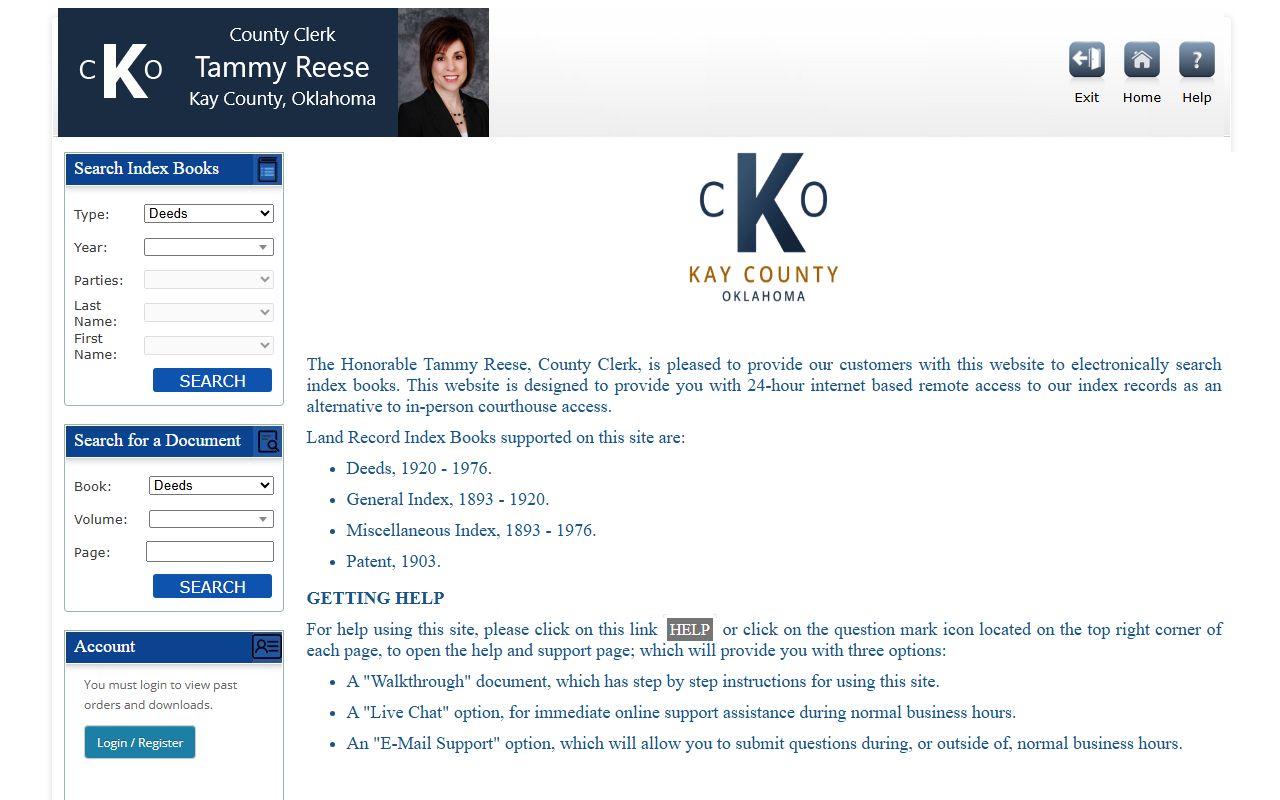
That portal covers deed and index books reaching back to the territorial era, which is where a probate estate's real-property history often leads. The same county site also gathers its current and historical record links in one place.
The County Clerk's quick-links page sorts those resources for the public, separating current land records from the older index books.
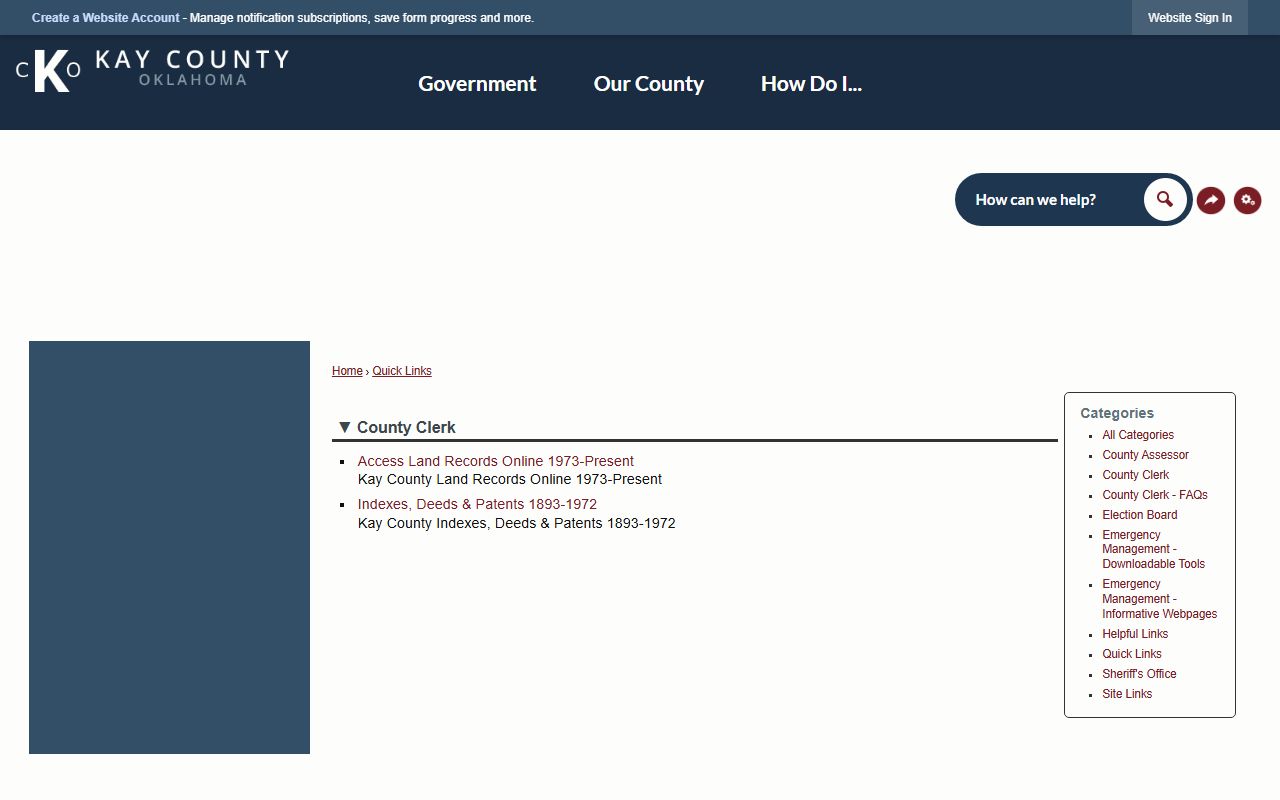
Use that page when a probate estate includes a house, farm, or mineral rights and you need the deed history. For the court case itself, stay with the Court Clerk and the District Court docket systems.
Staff contacts for the land-records office are published in the county directory, which lists the County Clerk's deputies and hours.
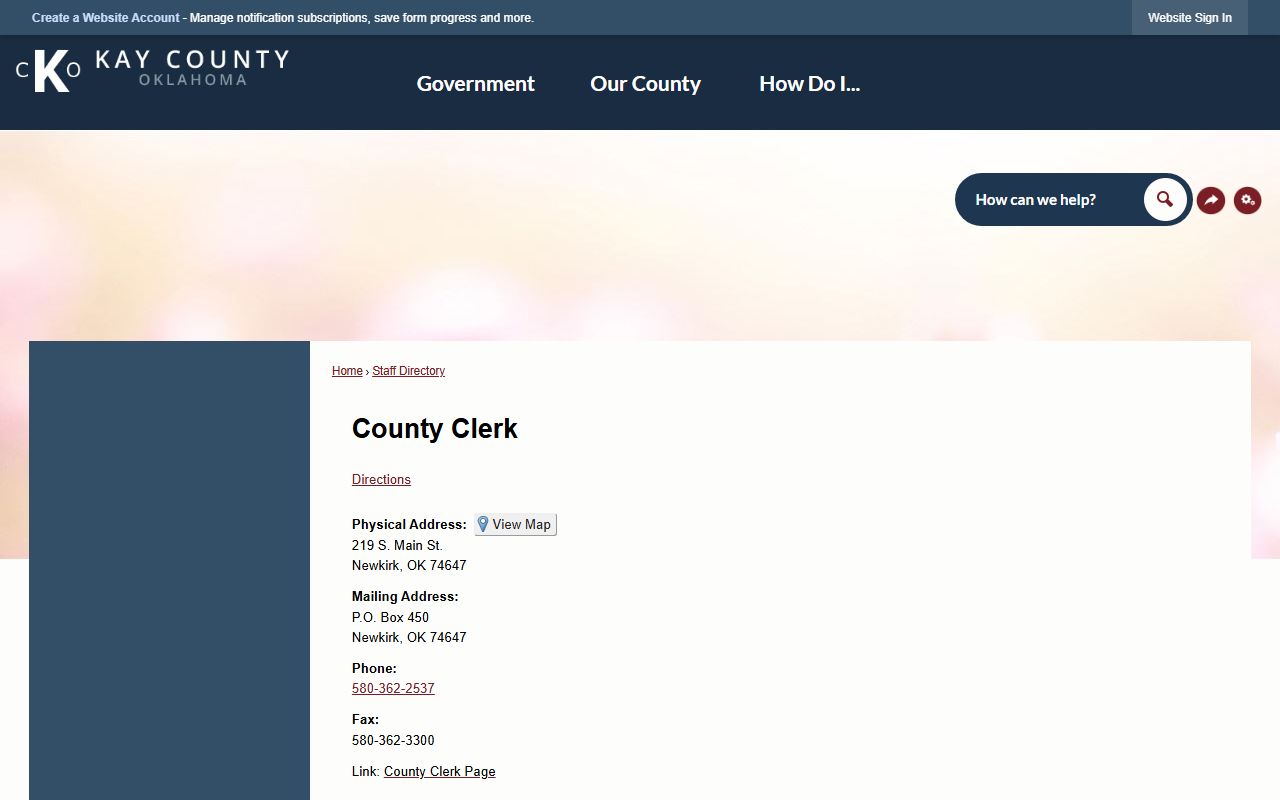
That directory is the right contact for deeds and liens tied to an estate, while the Court Clerk remains the office for the probate case file. Keeping the two straight saves a wasted trip.
Guardianship Records in Kay County
Guardianship cases share the probate docket but follow their own track. A guardianship gives someone legal authority over the care of a minor or an incapacitated adult, while a conservatorship focuses on managing money and property. Kay County's fee schedule treats these as distinct filings, with lower fees when a relative steps in for a family member.
A guardianship file can include the opening petition, medical or capacity evidence, the order appointing the guardian, and ongoing annual reports. Because guardians must account for their work, the court often requires regular reporting and may approve sales of the protected person's property. Those reports and sale motions appear in the case file over time.
Some content in a guardianship case is sensitive. Medical findings and details about a minor may be limited even when the case is otherwise public. Anyone needing a specific guardianship document should ask the Court Clerk what is releasable.
Restricted Probate and Adoption Records
Not every probate-adjacent file is open to the public in the same way. Adoption is the clearest example. Although adoption filings appear on the Court Clerk's fee schedule, they are highly restricted and should not be expected to show up in an ordinary online search the way an estate does. Treating adoption as a closed record is the safe assumption.
Other limits apply across the probate docket. Mental-health and incapacity material protected under state law may be sealed or redacted. Records involving minors carry extra protection. Personal identifiers such as Social Security numbers and financial account numbers are commonly removed before a document is released. A docket entry may be visible while the underlying image stays restricted.
When access is unclear, the Court Clerk is the place to ask. Staff can confirm whether a file is open, partly sealed, or closed, and they can explain what a member of the public is allowed to copy.
Note: Adoption records tied to a Kay County estate are treated as confidential, so do not assume they are searchable the way standard probate files are.
Small Estate Affidavits and Title 58
Not every estate needs a full probate case. Oklahoma's Title 58 includes small-estate affidavit provisions that let some qualifying property pass outside formal court probate. These shortcuts can save time and cost when an estate is modest and uncomplicated. They are a statutory tool, not a separate court filing tracked on the Kay County probate docket.
One specific form often causes confusion. Service Oklahoma offers a vehicle small-estate affidavit for transferring a car when the total estate value is no more than fifty thousand dollars. That is a state motor-vehicle document, handled through the motor-vehicle system, not a probate case filed with the Kay County Court Clerk. The two should never be merged. A vehicle affidavit will not appear in an ODCR or OSCN probate search because it is not a court case at all.
Anyone unsure whether an estate qualifies for a small-estate path or needs full probate should consult an attorney. The choice affects which records get created and where they end up.
Copies of Kay County Probate Records
Once a probate file is located, copies are available through the Court Clerk. The office charges a flat per-page rate, with a higher fee for the first page and a lower one for each page after. Certification, which makes a copy court-ready for legal use, carries its own per-instrument charge. The copy and certification fees come from the same published Kay County fee schedule that governs filings.
| Item | Amount |
|---|---|
| Copy, first page | $1.00 |
| Copy, each subsequent page | $0.50 |
| Certification of each instrument | $0.50 |
| Authentication of court record | $5.00 |
Plain copies work for personal reference and research. Certified copies are the ones banks, title companies, and other courts usually require. Requests can be made in person at the counter in Newkirk or by mail to the post office box, and a phone call ahead helps confirm the current total and accepted payment methods. The same offices and fee schedule govern copy requests across every District Court case type in the county.